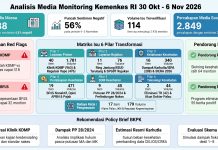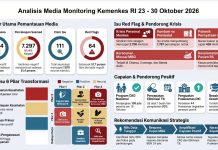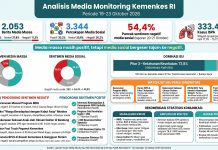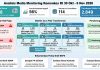

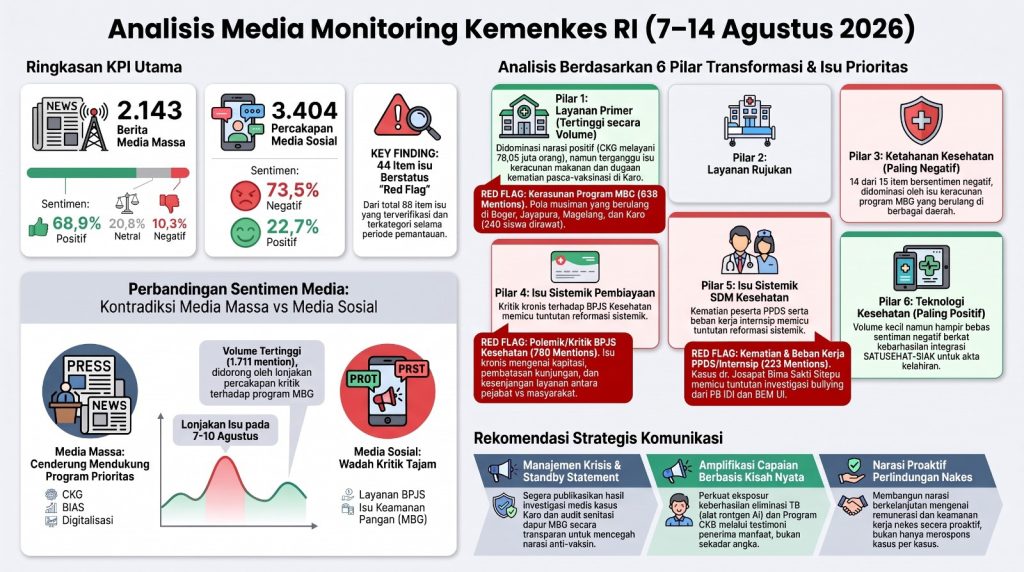
Media monitoring by the Indonesian Ministry of Health for the period August 7–14, 2026, revealed a sharp contradiction between mainstream news sentiment and public discourse. Of the 2.143 mass media stories, 68,9% were dominated by positive sentiment, supporting priority programs such as the Community Health Care and Digitalization Program (CKG) and digitalization. Conversely, of the 3.404 social media conversations, 73,5% were negative, making these platforms a platform for sharp criticism of BPJS services and food security, triggering 44 of the 88 issues categorized as crises or red flags.
From the perspective of the six pillars of health transformation, Pillar 1 (Primary Services) dominated the conversation volume, but was marked by red flags due to the high number of conversations regarding poisoning in the MBG Program and alleged post-vaccination incidents in Karo. These poisoning cases were repeated in various regions and contributed to Pillar 3 (Health Resilience) being the pillar with the most negative sentiment. Furthermore, critical sentiment also emerged in Pillar 4 in the form of systemic complaints about BPJS Kesehatan, and Pillar 5 related to the workload and the controversy over PPDS/Internsip deaths. Amid these various crises, Pillar 6 (Health Technology) recorded the most positive sentiment thanks to the successful integration of SATUSEHAT-SIAK.
As a corrective measure, the analysis recommends swift and transparent crisis communication tactics, such as publishing the results of the medical investigation into the Karo case and the MBG sanitation audit to counter the anti-vaccine narrative. The Ministry of Health is also encouraged to strengthen the amplification of program achievements through storytelling based on real-life beneficiary stories, rather than simply presenting statistics. Another crucial step is to build a more proactive narrative to ensure the protection, remuneration, and job security of healthcare workers to reduce the escalation of similar complaints in the future.