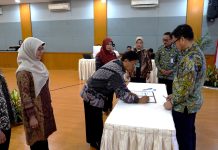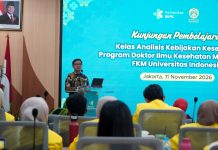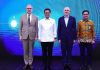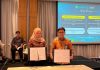


Jakarta – The dissemination of the 2023 Indonesian Health Survey (SKI) results was divided into two sessions: a panel session and a coaching clinic . The panel session covered the 2023 SKI results; methodology, sampling, and weighting of the 2023 SKI; validation of the 2023 SKI; utilization of 2023 SKI data; good practices for assisting with stunting programs; and cross-tabbing of SKI results with Susenas.
The Director of Survey and Census Methodology Development at the Central Statistics Agency (BPS), Sarpono, who presented the topic of Methodology, Sampling, and Weighting of the 2023 SKI in the first Panel session, stated that BPS oversees SKI activities in terms of methodology. Sarpono explained that the number of SKI samples was 34.500 Census Blocks or 345.000 households for the implementation of Riskesdas, 345.000 toddler households for the implementation of SSGI, and 2.500 Census Blocks or 25.000 households for the Biomedical sample. SKI is a survey with a household coverage. To ensure the representativeness of SKI, BPS built stratification into urban and rural strata. Sarpono further explained that the methodology that has been prepared for SKI has been designed in such a way to obtain maximum results.
Adding to the statement, the Director of People's Welfare Statistics of BPS, Ahmad Avenzora stated that BPS supports the provision of stunting data through involvement in the calculation and providing recommendations for survey methodologies that are sources of stunting data. The National Socio-Economic Survey (Susenas) conducted by BPS collects various information such as health information, education, employment, access to food, housing, household expenditure, etc. The indicators produced by Susenas can be used to evaluate programs to accelerate stunting reduction, both specific nutritional interventions and sensitive nutritional interventions. Sensitive nutritional interventions are carried out to address the direct causes of stunting. SKI, according to Avenzora, is only carried out specifically for health topics.
Meanwhile, Abdul Razak Thaha, the SKI Expert Team from the Muhammadiyah University of Jakarta who gave a presentation on Good Practices for Assisting the Stunting Program, said that surveys are the most valid available data to determine the prevalence of stunting. Survey data should be the main source at the district/city level to identify precisely the weakest points for the entry of new stunting and risk factors that need to be addressed immediately. However, the consequence is that the socialization of survey data must be accelerated, the SKI team needs to complete all its work by providing data that has been analyzed at the district/city level and it is necessary to design an appropriate assistance pattern for districts/cities in utilizing survey data and other data.

Regarding the validation of SKI data, the SKI Validation Team from the University of Indonesia Sabarinah said that the validation carried out was an external validation preceded by internal validation. The purpose of validation is to obtain information on whether the data collected is valid. For the validation of SKI 2023, the purpose is to see the process and output of SKI 2023 whether it is in accordance with the limitations/definitions/plans or procedures. Validation was carried out from August to September 2023. The selection of validation area samples was divided into 5 regions, namely Sumatra, West Java-Jakarta-Banten, Central Java-Yogyakarta, East Java-Bali-Kalimantan-NTB, and Sulawesi-Maluku-Papua-NTT. From the results of the validation carried out, it was stated that there was a need to strengthen training for enumerators. The training includes improving understanding of the operational definition of each question, interview skills with probing and use of teaching aids, measuring skills (anthropometry and blood pressure), and skills in preparing preconditions for biomedical laboratory examinations (fasting terms) and dental and oral examinations.

Regarding how to utilize the data, the SKI Expert Team from the University of Indonesia Iwan Ariawan explained that SKI data can be utilized to develop data-based programs/interventions (evidence-based public health). Iwan also said that the 2023 SKI raw data is easier to access. The data will be provided in full, without the need to select variables. Later, not only the data will be provided but also the 2023 SKI Data Analysis Guidelines. The book explains in detail the SKI data analysis process, how to conduct the analysis correctly, how to use weights, etc. Therefore, Iwan appealed to the public to utilize the data.
Next, on the following day, a Coaching Clinic was held, namely a consultation for participants who wanted to ask more detailed questions about SKI data with experts and the SKI technical team. (Author Kurniatun/Edit Timker HDI)