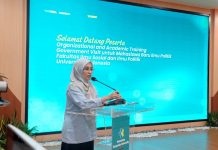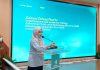

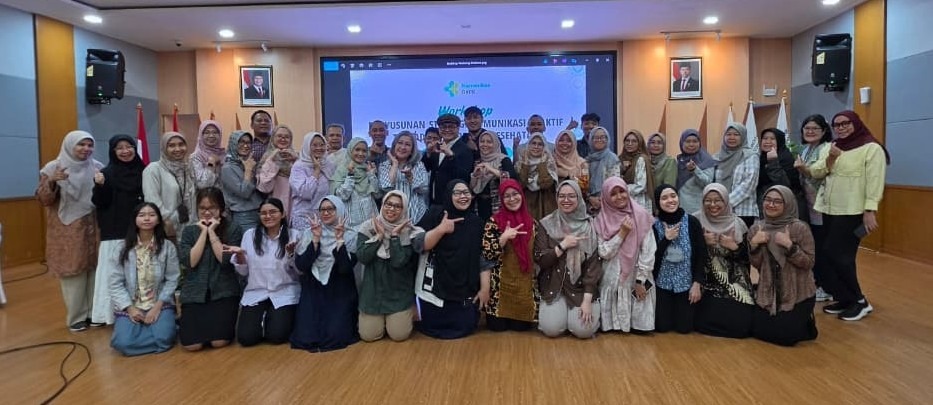
Jakarta – Secretary of the Health Development Policy Agency (BKPK) of the Ministry of Health, Etik Retno Wiyati, hopes that the Reactive Communication Strategy Workshop held on Wednesday (26/8) can increase the quantity and quality of communication products produced by the public relations team within the BKPK of the Ministry of Health. Etik expressed this hope when opening the two-day event, which was attended by approximately 40 participants consisting of Public Relations Officers, Policy Analysts, Health Administration, Personnel Analysts, Librarians and General Functional Positions within the BKPK and the Public Communication and Public Information Bureau of the Secretariat General of the Ministry of Health, the Ministry of Finance, the Ministry of Religious Affairs, and the Secretariat of the Bogor City DPRD.
In his remarks, Etik commended the BKPK's public relations and communications management teams, who he considered active in organizing knowledge-sharing activities across ministries and institutions. He stated that such activities are necessary to continue, given the current rapid pace of public communication. "Hopefully, this workshop will increase the quantity and quality of communication products produced," Etik said in his remarks.
"We understand that public communication is currently moving very quickly. People have easy access to information, and literacy levels also vary," he said. According to Etik, this difference in literacy levels makes it easy for unconfirmed information to spread across various digital platforms and social media. This situation, he said, requires government communication channels to act quickly to balance the flow of information developing in society.
He added that the health sector is one of the sectors most affected by issues compared to other ministries and regional governments, so the role of communications officials and public relations personnel is required to be more effective.
"The challenge for government communications is no longer simply conveying information, but rather understanding the issues, reading the dynamics of the issue, then recognizing how the public perceives an issue, formulating the right message and using the appropriate channel," said Etik.
Etik warned that an inappropriate response to an issue could potentially trigger a larger public backlash. Therefore, he hoped participants would practice media monitoring-based issue analysis directly during the workshop.
The workshop's Issue Analysis material was presented by Jojo S. Nugroho, a communications practitioner known as "Om Jojo." He served as Chairman of the Indonesian Public Relations Association (APPRI) from 2017 to 2024, as well as being the founder and Chief Executive Officer (CEO) of Imogen PR.
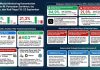
Jojo presented material on sentiment, tonality, and news framing as necessary steps before developing a public communications strategy. He explained that reading public issues ideally involves a series of processes, starting with gathering news signals, understanding the facts, identifying the context, assessing the impact on stakeholders, and formulating communication response recommendations.
In his presentation, Jojo also reminded that media sentiment and public sentiment in the digital space often exist on two different levels, so organizations cannot simply monitor media coverage without reading public conversations on social media.
He cited several real-life cases in the health sector as analytical exercises, including news reports on the impact of forest and land fire haze on acute respiratory infections, allegations of food poisoning during the Free Nutritional Meal program, and the viral comments made by healthcare workers about BPJS Kesehatan patients. From these cases, Jojo emphasized the importance of reading the entire news story, not just the headline, before determining the sentiment or risk level of an issue.
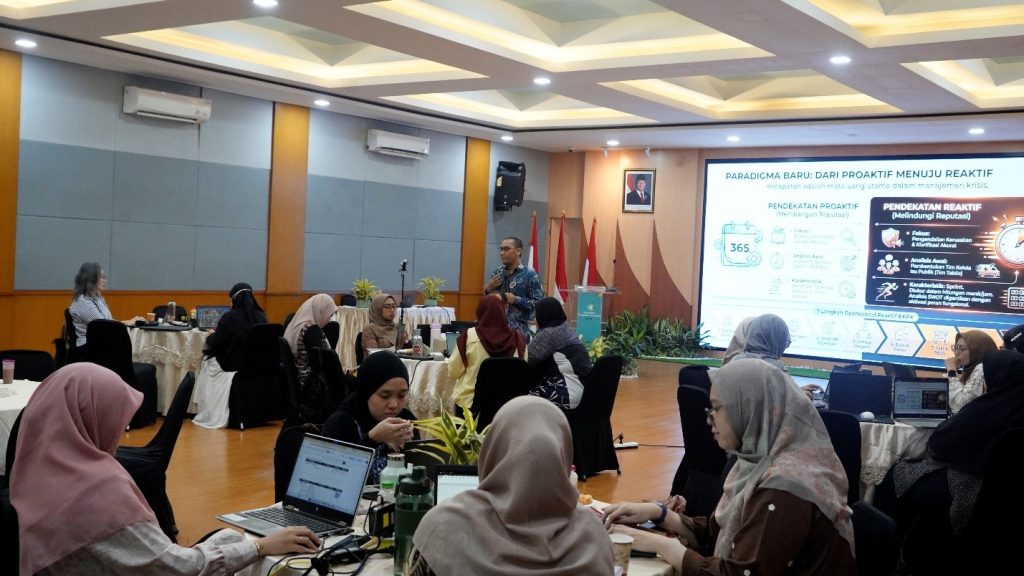
The next topic, regarding the development of reactive communication strategies, was delivered by Fachrudin Ali, an Associate Expert Public Relations Officer at the Ministry of Health's Corruption Eradication Commission (BKPK) and Chairman of the Indonesian Public Relations Association (Iprahumas). Fachrudin emphasized that government organizations need to shift from a communications approach that solely builds reputation to one that can protect it when issues escalate rapidly. "Speed is the key currency in crisis management," Fachrudin said.
He explained that while a proactive approach is like a marathon with scheduled, cross-sectoral organizational analysis, a reactive approach demands a sprint, measured in minutes to hours, with the initial analysis consisting of the formation of a public issues management team rather than a lengthy SWOT analysis. According to Fachrudin, roles within the team must be structured based on function, not structural position, to ensure protocols remain in place despite staff rotation.
He also emphasized the importance of filling information gaps during critical times to prevent the narrative from being taken over by others. "Any information gap left empty will be filled by others, and that could lead to disinformation (hoaxes)," Fachrudin explained. (FAA)