Ditapis dengan
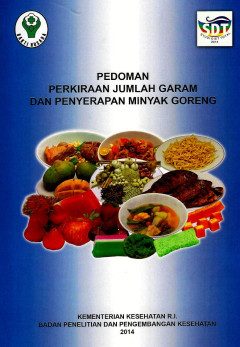
Pedoman Perkiraan Jumlah Garam dan Penyerapan Minyak Goreng
- Edisi
- -
- ISBN/ISSN
- 978-602-235-592-2
- Deskripsi Fisik
- 20p.; 21cm
- Judul Seri
- -
- No. Panggil
- Ref QU 146 ERN 2014
- Edisi
- -
- ISBN/ISSN
- 978-602-235-592-2
- Deskripsi Fisik
- 20p.; 21cm
- Judul Seri
- -
- No. Panggil
- Ref QU 146 ERN 2014

Penggunaan Garam Beriodium Rumah Tangga Di Desa Ngabean Kecamatan Secang (Usi…
lodized salt program have obstacles from the level of salt producers to the community level. The current situation shows the number of circulating non-iodine salt on the market. There still many households do not consume good quality of iodized saft. The purpose of this study obtain in-depth information about the knowledge and behavior of housewives the selection, storage and use of iodized sal…
- Edisi
- -
- ISBN/ISSN
- 2086-5198
- Deskripsi Fisik
- 12p
- Judul Seri
- -
- No. Panggil
- Media Gizi Mikro Indonesia, 3 (2) 2012 : 87-98
Peran Dan Potensi Kader Kesehatan Dalam Kegiatan Deteksi Dini Dan Pemantauan …
Consumption of iodized salt is one of the efforts to control lodine Oeficiency Oisorders (100). Supervision for the use of iodized salt needs to be monitored to observe what kind of saft consumed by people. Early 100 detection activities for infants aged 0-3 months is also an important activity to be done because the earlier 100 ca se found in children, the more likely the child can grow normal…
- Edisi
- -
- ISBN/ISSN
- 2086-5198
- Deskripsi Fisik
- 10p
- Judul Seri
- -
- No. Panggil
- Media Gizi Mikro Indonesia, 3 (2) 2012 : 77-86
Determinan Sosial Ketersediaan Garam Rumah Tangga Berkualitas di Desa AIK BER…
- Edisi
- -
- ISBN/ISSN
- -
- Deskripsi Fisik
- 96p
- Judul Seri
- -
- No. Panggil
- 300 LIT
- Edisi
- -
- ISBN/ISSN
- -
- Deskripsi Fisik
- 96p
- Judul Seri
- -
- No. Panggil
- 300 LIT
Iodine Salt Consumption in Indonesian Households: Baseline Health Survey 2007
Background: Iodine Deficiency Disorder (100) reduction program has been implemented since 1976. According to the National Economic Survey 2002, the average consumption of iodized salt was 6. 26 grams. The results of Iodine Salt Survey (SGY) 2003 showed that the consumption of iodine salt at the household level was 73.2%, meanwhile, the baseline health survey (Riskesdas) 2007 showed there was re…
- Edisi
- -
- ISBN/ISSN
- 1410-2935
- Deskripsi Fisik
- 7p
- Judul Seri
- -
- No. Panggil
- Buletin Penelitian Sistem Kesehatan, 14 (2) 2011 :
Hubungan Faktor Perbedaan Individual Dan Ketersediaan ' Garam Di Warung Denga…
IDD would be serious health problem. Behavior in salt iodization was influenced by individual dijJerence and environments. Th is study will examine relationship between individual dijJerence and availability ofiodized salt in the shop with salt iodization behavior in Purworejo. Regency. Observational research with cross sectional. This research in Ngombol Village, Purworejo Regency. Research wa…
- Edisi
- -
- ISBN/ISSN
- 2086-5198
- Deskripsi Fisik
- 8p
- Judul Seri
- -
- No. Panggil
- Media Gizi Mikro Indonesia 1 (4) 2011 : 135-142
Bentuk dan Penggunaan Garam Beryodium pada Tingkat Rumah Tangga
Background: In the market, salt is available in the form of powder (table salt), granule (raw salt) or bricked (pressed salt). Salt has been used as vehicle for iodine fortification since end of 1970s. This iodised salt is set as the long term strategy to control iodine deficiency. lodised salt is also available in those three forms. lodised salt survey at household level was conducted in 2007 …
- Edisi
- -
- ISBN/ISSN
- 0125-9717
- Deskripsi Fisik
- 8p
- Judul Seri
- -
- No. Panggil
- Penelitian Gizi dan Makanan, 33 (1) 2010 : 51-58
The Goodness of Salt Quick Test as Compared to Titration Method for Mass Scre…
Diagnostic study on Quick salt test and titration methods toward Urine Intake Excretion (UIE) level in Indonesia had been conducted after the baseline data of Iodine salt available (Riskesdas 2007). For the baseline, samples were selected purposively covering households of 30 districts/municipalities based on the previous Iodine Salt Survey (SGY 2993). The dependent variable was Iodine level of…
- Edisi
- -
- ISBN/ISSN
- 1410-2935
- Deskripsi Fisik
- -
- Judul Seri
- -
- No. Panggil
- Buletin Penelitian Sistem Kesehatan, 13(3): 224-23
Kadar iodium garam konsumsi di tingkat rumah tangga secara semi kuantitatif d…
- Edisi
- -
- ISBN/ISSN
- -
- Deskripsi Fisik
- 24 p
- Judul Seri
- -
- No. Panggil
- 575 GIZ
- Edisi
- -
- ISBN/ISSN
- -
- Deskripsi Fisik
- 24 p
- Judul Seri
- -
- No. Panggil
- 575 GIZ
Perilaku konsumsi garam beriodium pada rumah tangga di kecamatan Incin Jaya k…
- Edisi
- -
- ISBN/ISSN
- -
- Deskripsi Fisik
- 10 p.
- Judul Seri
- -
- No. Panggil
- 58 LIT
- Edisi
- -
- ISBN/ISSN
- -
- Deskripsi Fisik
- 10 p.
- Judul Seri
- -
- No. Panggil
- 58 LIT
 Karya Umum
  Filsafat
  Agama
Agama  Ilmu-ilmu Sosial
  Bahasa
  Ilmu-ilmu Murni
  Ilmu-ilmu Terapan
  Kesenian, Hiburan, dan Olahraga
  Kesusastraan
  Geografi dan Sejarah